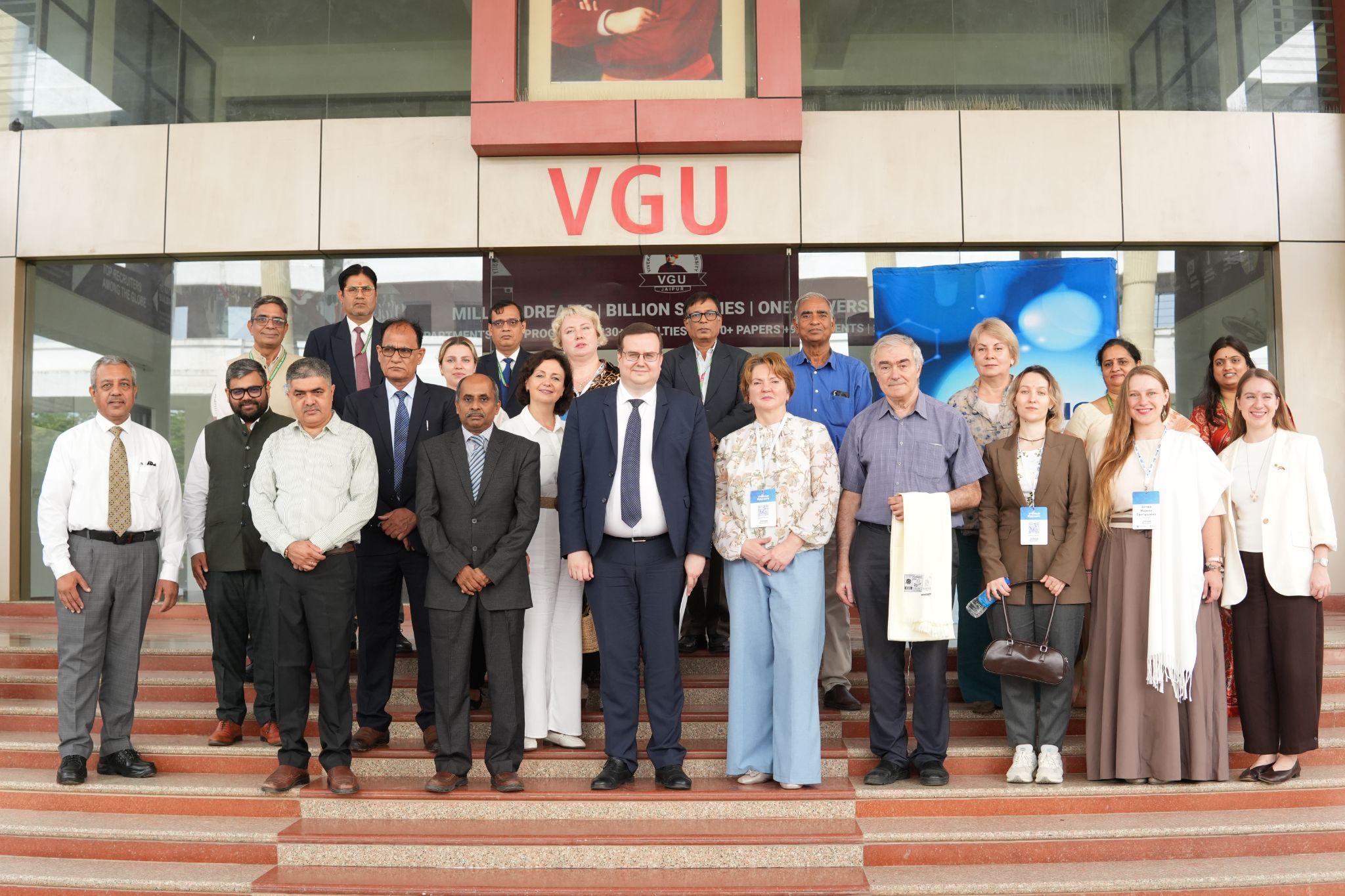
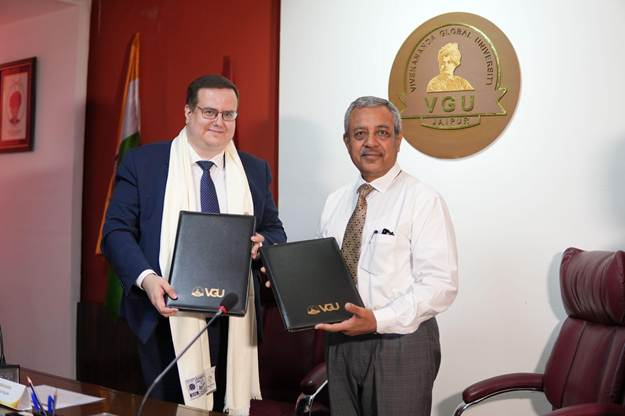
October 3, JAIPUR - Vivekananda Global University (VGU), Jaipur, hosted an India–Russia academic exchange programme that brought together academics and researchers from Russian institutions, with the signing of a Memorandum of Understanding (MoU) between VGU and the Pushkin State Russian Language Institute forming a key part of the programme.
The agreement is intended to expand academic and research cooperation, promote Russian language and cultural studies, and create opportunities for student and faculty exchanges, joint academic programmes, lectures, workshops and collaborative research.
The programme brought Russian academics into direct interaction with VGU students through sessions spanning linguoculturology, bilingualism, history, neuroscience, language teaching, culture and scientific research. Students were also introduced to opportunities for higher education and academic exchange in Russia.
Dr D.V.S. Bhagavanulu, President of Vivekananda Global University, spoke about the longstanding academic and cultural connections between India and Russia and the role of educational cooperation in bringing young people from the two countries together through knowledge, culture, research and innovation. He also referred to the history of India–Russia cooperation in areas including education, science and technology.
VGU Chief Executive Officer Onkar Bagaria described the collaboration as an important step towards strengthening international academic engagement. He said such initiatives provide students with opportunities to interact with international experts, explore research and gain exposure to global academic and career avenues.
The programme began with a working meeting between Indian and Russian representatives to discuss prospects for cooperation. VGU Pro-President Prof (Dr) Baldev Singh delivered the welcome address, while Registrar Dr Praveen Choudhary also addressed the gathering.
Speaking about the value of international and interdisciplinary academic engagement, Prof (Dr) Baldev Singh said: “In an era defined by rapid technological advances, global challenges demand global perspectives.”
He also emphasised opportunities for cooperation through joint research projects, faculty exchange programmes, student immersion visits and cultural dialogue between institutions in India and Russia.
Strengthening India–Russia academic cooperation
Nikita Vladimirovich Gusev, Rector of the Pushkin State Russian Language Institute, highlighted the developing academic and scientific partnership between India and Russia during the Scientists of the Future 2026 programme.
Gusev noted that 2027 will mark the 80th anniversary of India–Russia diplomatic relations and described the anniversary as an opportunity to further develop cooperation in science, education, research and academic exchange.
He also addressed the importance of interdisciplinary collaboration and joint academic initiatives involving institutions in India and the Russian Federation, highlighting the role of programmes such as Scientists of the Future in connecting young researchers and scholars.
Gusev referred to the visit of five Russian scholars to VGU, Jaipur, and their engagement with students and academics on research, education and the development of future scientific cooperation. Members of the delegation included Evgenia Vladislavovna Pushchina, Irina Anatolyevna Leshutina and Vladimir Ilyich Karasik, along with other participating scholars.
Language, bilingualism and culture
Vladimir Ilyich Karasik, Doctor of Philology and Professor at the Pushkin State Russian Language Institute, explored bilingualism from social and cultural perspectives, using India as an example of the diversity found within multilingual societies.
He discussed different forms of bilingualism, including natural bilingualism, migrant bilingualism and professional bilingualism, and examined their relationship with communication and cognitive development.
Karasik also addressed the close connection between language and culture. His session considered different levels of language acquisition and the difficulties that can arise when culturally specific words, concepts and expressions are translated between languages.
Adding a cultural dimension to the discussion, Karasik shared that his favourite Indian word is “Rangoli”, using it as an example of how words can carry cultural meaning and identity beyond their literal translation.
Opportunities for students and educational exchange
Anastasia Ilyushina, Coordinator of Youth Projects and Programmes at the Russian House in New Delhi, focused on educational opportunities associated with the Pushkin State Russian Language Institute.
She explained how students can apply to the institution and outlined aspects of the application process and opportunities for academic study. Her session also addressed higher education, educational exchange and cross-cultural learning between India and Russia.
Ilyushina later conducted a session involving linguistic experiments with the Russian language, providing students with another opportunity to engage with the language through an interactive academic setting.
Science, history and language teaching
The programme featured specialist sessions covering several academic disciplines.
Anastasia Igorevna Dokuchaeva, Candidate of Technical Sciences and Senior Researcher at PIKON RAS, spoke about the science behind spontaneous coal ignition.
Marina Grigorievna Zagora, Candidate of Historical Sciences and Researcher at the Faculty of History at Lomonosov Moscow State University, examined cultural ties between the Russian Empire and India during the 19th and early 20th centuries.
Irina Anatolyevna Leshutina, Doctor of Philology and Associate Professor at the Pushkin State Russian Language Institute, conducted a master class on enhancing learning motivation in the teaching of Russian as a foreign language.
The science-focused component of the programme included a session by Evgenia Vladislavovna Pushchina, Doctor of Biological Sciences and Professor of the Russian Academy of Sciences, who discussed the role of astrocytes in plasticity and metabolism in the vertebrate brain.
Arina Martynova of the International Department of the Pushkin State Russian Language Institute discussed Russian language, culture and communication, as well as academic opportunities available to students interested in studying in Russia.
Scientists of the Future
The programme also included a business session involving participating experts and activities under the Scientists of the Future initiative. The programme enabled students to engage directly with Russian academics and researchers representing different disciplines and to learn about research, education and international academic cooperation.
The combination of the institutional agreement and academic sessions provided a framework for further engagement between VGU and the Pushkin State Russian Language Institute in areas including language and cultural studies, student and faculty mobility, academic programmes, research and knowledge exchange.